Bloom International SchoolIB candidate schoolIB Candidate SchoolPrimary Years Programme
Book aVisit
✕
Explore BIS IB Candidate School · PYP
Home →
01 About BISWho we are ▼
02 Academics4 stages, age 3–18 ▼
03 AdmissionsJoin the BIS family ▼
04 School LifeBeyond the classroom ▼
05 News & EventsWhat’s happening ▼
Come and see us.
Book a campus tour or send us a question — we reply within one working day.
Book a Visit →
Home› Academics
IB Candidate School · PYP Ages 3–18 · PK3 to Grade 12

Academics

One learning journey from age 3 to 18 — Early Childhood, Primary School, Secondary School and Pre-University, each stage building the foundation for the next.

A teacher leading a class discussion while students raise their hands
The Bloom journey

One continuum,
age 3 to 18.

Four stages, one philosophy. A learner who begins in Early Childhood moves through Primary and Secondary School and finishes in Pre-University, ready for university — without ever changing schools.

Bloom International School is an IB candidate school* for the International Baccalaureate Primary Years Programme (PYP) — candidacy does not guarantee authorization. Classes currently run from Pre-K to Grade 5, with further grades opening as the school grows. Which grade is my child? ›
How we learn

Learning by asking,
not by copying.

Across every division our students learn through inquiry, build conceptual understanding, and become agents of their own learning — partners in the process rather than recipients of it.

Students working together on an inquiry project
?
Inquiry-based learning
Children learn by exploring, discovering, and making real-life connections.
◎
Conceptual understanding
Big ideas that transfer between subjects, contexts and countries — not facts in isolation.
✦
Student agency
Students act as agents of their own learning and partners in the learning process.
⌘
International-mindedness
A strong regard for cultural diversity and a genuine global commitment.
Language of instruction
English, with Khmer, Spanish, French and Mandarin Chinese
Core academic subjects are taught in English, complemented by a Khmer program emphasising language, history and culture. Additional languages are introduced gradually from Grade 1.
IB learner profile

Ten attributes we teach for

Tap an attribute to see what it looks like in a Bloom classroom.

Learn more about the IB learner profile →

See our dedicated IB learner profile page →

Inquirers
We nurture our curiosity, developing skills for inquiry and research. Children learn by exploring, discovering, and making real-life connections. At Bloom, lessons begin with wonder and a real question - curiosity is where learning starts.
Watch: the IB learner profile

Ten attributes, one film

This short film from the International Baccalaureate explains the learner profile - the ten attributes above - in the IB's own words.

Read the official IB learner profile description →

Why choose our Early Childhood program?

A love of learning,
from the very first steps.

01
Inquiry-Based Learning
Children learn by exploring, discovering, and making real-life connections.
02
Nurturing Teachers
Specialists who provide a supportive atmosphere celebrating every child's uniqueness.
03
Holistic Growth
Balanced development in language, arts, math, science, and physical education.
04
Creative Expression
Nurturing imagination through art, music, drama, and hands-on creative activities that build confidence and self-expression.
05
Play-Based Learning
Learning through exploration and play, fostering natural curiosity while developing essential cognitive and social skills.
An Early Childhood classroom moment
Our Early Childhood program

Hands-on, whole-child,
ages 3 to 5.

Our Early Childhood program provides children ages 3 through 5 with a comprehensive, hands-on educational experience that supports cognitive, social-emotional and physical development, as well as language and communication skills.

We believe in inquiry learning and provide spaces and experiences for students to explore, discover, and make real-life connections. Concepts and skills are taught through an integration of language arts, math, science, physical education, and social and fine arts activities. Exposure to various social, sensory, motor, artistic and pre-academic activities ensures strong foundations during the early stages of child development.

IB PYP parent pack: FAQs about the PYP (official IB brochure) →

Our teachers are Early Childhood specialists who provide a nurturing and supportive atmosphere that celebrates the uniqueness of every child.
A child at a learning centre
The PYP in action

See how the PYP comes alive

The IB Primary Years Programme model diagram
The IB Primary Years Programme model - © International Baccalaureate Organization

Video: "PYP in Early Years" from the official IB channel. Diagram: the official IB PYP programme model. Both used for informational purposes.

Age-appropriate programs

Three steps into school

Toddlers
18 months – 3 years
Sensory exploration activities
Basic social interaction skills
Language development through songs
Simple problem-solving games
Fine motor skill development
Pre-Kindergarten
3 – 4 years
Early literacy and phonics
Number recognition and counting
Creative arts and crafts
Cooperative play and sharing
Basic independence skills
Kindergarten
4 – 5 years
Pre-reading and writing skills
Mathematical reasoning
Scientific investigation
Complex social interactions
Preparation for primary school
Our learning environment

Built around small people

Inspiring Classrooms
Bright, welcoming spaces designed for young learners
Age-appropriate furniture and learning materials
Dedicated learning centers for different activities
Safe, clean, and stimulating environments
Outdoor Spaces
Secure outdoor play areas with natural elements
Age-appropriate playground equipment
Garden spaces for nature exploration
Shaded areas for outdoor learning activities
Expert Educators
Qualified early childhood specialists
Passionate, caring, and experienced teachers
Ongoing professional development
Low student-teacher ratios for individual attention
Safety & Wellbeing
Comprehensive health and safety protocols
Secure campus with controlled access
Regular health screenings and monitoring
Nutritious meals and snacks provided daily
Next step: Primary School
Kindergarten leads straight into Primary School in Grade 1.
Our Primary School program

Primary School,
Grades 1 to 5.

Students learn through inquiry and build conceptual understanding while becoming agents of their own learning and partners in the learning process.

BIS is an IB candidate school* for the Primary Years Programme (PYP). The PYP framework is defined by six transdisciplinary learning themes that transcend borders, connecting to what is real in the world — and those themes explore knowledge drawn from seven disciplinary areas.

IB PYP parent pack: FAQs about the PYP (official IB brochure) →
6
transdisciplinary themes
7
disciplinary areas
5
languages in the timetable
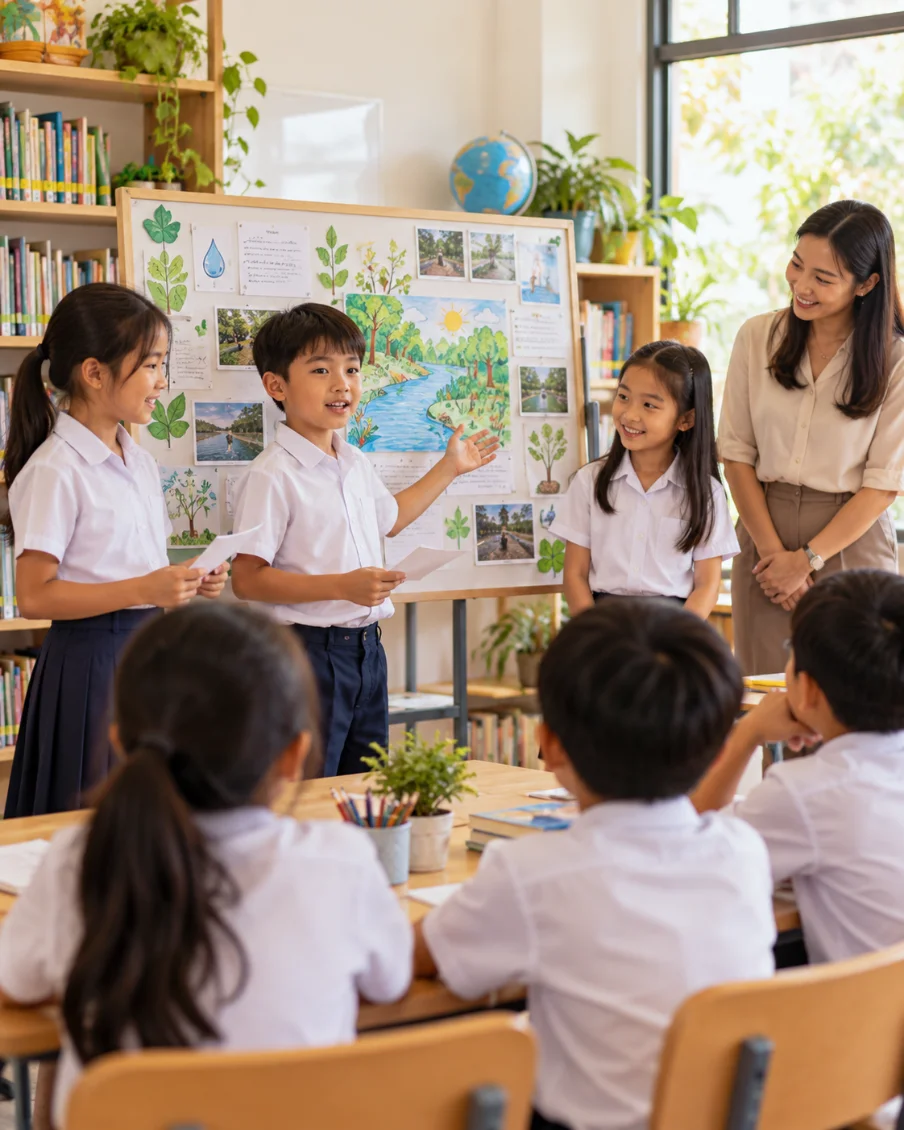
Primary students presenting an inquiry
01
Inquiry-Based Learning
Encourages curiosity, problem-solving, and critical thinking in every subject.
02
Multilingual Education
Students gain exposure to multiple languages, fostering communication skills.
03
Global Curriculum
Inquiry-based learning connects students to the world beyond the classroom.
The IB Primary Years Programme model diagram
The IB Primary Years Programme model - © International Baccalaureate Organization
The PYP at a glance

One model, three pillars

The learner, learning and teaching, and the learning community - three pillars held together by agency and action. This is the framework behind every Primary unit your child studies.

Read about the PYP on the official IB site →

Six transdisciplinary themes

Questions that cross
every subject

Who We Are
An inquiry into the nature of the self; beliefs and values; personal, physical, mental, social and spiritual health; human relationships including families, friends, communities, and cultures.
Where We Are in Place and Time
An inquiry into orientation in place and time; personal histories; homes and journeys; discoveries, explorations and migrations of humankind; the relationships between individuals and civilizations.
How We Express Ourselves
An inquiry into the ways in which we discover and express ideas, feelings, nature, culture, beliefs and values; the ways in which we reflect on, extend and enjoy our creativity.
How the World Works
An inquiry into the natural world and its laws; the interaction between natural and human-made systems; the impact of scientific and technological advances on society and the environment.
How We Organize Ourselves
An inquiry into the interconnectedness of human-made systems and communities; the structure and function of organizations; societal decision-making; economic activities and their impact.
Sharing the Planet
An inquiry into rights and responsibilities in the struggle to share finite resources with other people and living things; communities and the relationships within and between them; access to equal opportunities.
Seven disciplinary areas

Where the knowledge comes from

Social Sciences
History, geography, culture, and citizenship
Natural Sciences
Biology, chemistry, physics, and environmental studies
Technology
Digital literacy, coding, and innovation
Languages
English and multilingual development
The Arts
Visual arts, music, drama, and dance
Mathematics
Numbers, patterns, problem-solving, and reasoning
PSPE
Personal, social, and physical education
Multilingual learning environment

Five languages,
introduced gradually

All subjects are taught in English, complemented by additional language programs introduced gradually throughout the primary years.

Instruction
English
Primary language of instruction for all subjects
4–5 hrs / week
Khmer
Language, history and culture — introduced gradually
Weekly → 2 hrs
Spanish
Once a week until Grade 2, then enhanced frequency
Weekly → 2 hrs
French
Once a week until Grade 2, then 2 hours from Grade 3
2 hrs / week
Chinese
Mandarin, 2 hours per week from Grade 1 onwards
Next step: Secondary School
Grade 5 leads into Secondary School in Grade 6.
Secondary students in a lab
Secondary School

Grades 6 to 10,
from the classroom to the real world.

After entering secondary school, our students take on a broader and more demanding curriculum — from Grade 6 through to Grade 10.

This program encourages students to be risk-takers, critical thinkers and creative problem solvers who can apply what they've learned in the classroom to the real world. It helps students acquire researching, thinking, communicating and management skills. Our students must have a strong regard for cultural diversity and global commitment.

Why choose our Secondary program?

Five reasons families choose BIS

01
Critical Thinking
Develop analytical skills and independent thinking through inquiry-based learning and real-world problem solving.
02
Global Perspective
Foster international-mindedness and cultural awareness through a diverse curriculum and global connections.
03
Personal Excellence
Support individual growth and achievement through personalized learning paths and mentorship programs.
04
Innovation & Technology
Students engage with cutting-edge technology, coding, robotics, and digital literacy to prepare for the future workplace.
05
Rigorous Curriculum
Students explore local and global contexts, developing cultural awareness and international-mindedness through inquiry-based learning.
Secondary students in a robotics club
Six broad areas of knowledge

The Secondary curriculum
at Bloom

Mathematics
Developing logical reasoning and problem-solving skills through comprehensive mathematical concepts and applications.
Sciences
Exploring the natural world through inquiry-based learning and hands-on experimentation across multiple disciplines.
Individuals and Societies
Understanding human behavior, cultures, and societal structures through historical and contemporary perspectives.
Physical and Health Education
Promoting physical wellness, teamwork, and healthy lifestyle choices through diverse sporting activities.
Design, Arts, Language and Literature
Fostering creativity, expression, and communication skills through artistic and literary exploration.
Language Acquisition
Building multilingual competency and cultural understanding through comprehensive language learning programs.
Languages in Secondary School

The years the levels
become certificates.

Core subjects are taught in English. Alongside them, Grades 6 to 10 are where language study stops being exposure and starts being assessed against published international levels — with the first external certificates earned before students leave Grade 10.

Khmer ភាសាខ្មែរ
The official language of Cambodia, compulsory at BIS from Kinder through to Grade 10.
Grades 6–10
Language, History & Culture
Proficiency in Khmer and cultural identification.
Spanish Español
Compulsory from Grade 1 to Grade 8, then an elective from Grade 9 onward.
Grades 6–10
Nivel A2 → B1
Novice into Intermediate, on the way to the DELE.
French Français
Compulsory for Grades 1 to 8, then an elective from Grade 9 onward.
Grades 6–10
Novice A2 → B1
After Grade 10, students may earn the DELF B1.
Chinese 中文 · Mandarin
Compulsory from Grade 1 all the way through Grade 10.
Grades 6–10
YCT 3 → YCT 4
After Grade 8, students may earn the YCT 4.
Full language programme
Every level, from Pre-K to Grade 12, is set out on BIS Languages Programs — including the DELE, DELF and HSK certifications.
After Grade 10

One journey,
all the way through

Secondary School leads directly into our final two years — no change of school, no gap in the journey.

Grades 11–12
Pre-University
After Grade 10, students move into the final two years of the Bloom journey — preparing for university, careers and a meaningful life beyond school.
Pre-University · Grades 11–12

The last two years,
and what comes
after them.

Our Pre-University stage prepares students for university, careers and a meaningful life beyond school. Students take on greater independence, sharpen their academic writing and research, and build the portfolio and references a university application needs.

Growing with our students
BIS currently offers classes from Pre-K to Grade 5. Our Pre-University stage opens as each cohort reaches it, and we will publish full details closer to the time.
An older student studying
What this stage is for

Ready for what
comes next.

University
Applications and entry
Guidance through university research, applications, references and entrance requirements, in Cambodia and abroad.
Careers
Direction with purpose
Time to explore where a subject actually leads — internships, mentors, and conversations with people doing the work.
Independence
Learning to run yourself
Research, academic writing, time management and the study habits a first year of university takes for granted.
The two years

What Grade 11 and
Grade 12 look like

Two years with different jobs to do. The first is for breadth, settling into independent study and finding the direction; the second is for applications, examinations and finishing well.

Grade 11
Foundations & direction
Subject choices settleStudents commit to the subjects they will carry into Grade 12, with guidance from teachers who have taught them for years.
Independent study habitsResearch, academic writing and referencing taught as skills in their own right.
First conversations about universityWhere, what, and what it will take — early enough to act on the answer.
Service and leadershipResponsibility inside the school: leading a club, mentoring younger students, running an event.
Grade 12
Applications & finishing
University applicationsShortlists, personal statements, references and deadlines — managed with the school, not alone.
External examinationsSat in the final year; entry fees are listed separately on the fee schedule.
Language certificationThe DELE, DELF and HSK sit in these years for students who have carried a language through.
GraduationThe end of the Bloom journey, marked properly — and the start of the alumni relationship.
University guidance

Nobody applies
on their own.

Applying to university from Cambodia means navigating several systems at once — Cambodian, American, British, Australian, European. Guidance is built into the timetable rather than left to a single appointment.

Research
Finding the right fit
Course and country research, entry requirements, and an honest conversation about what each option costs.
Applications
Written with support
Personal statements and essays drafted, read and redrafted with a teacher who knows the student.
References
Written by people who know them
A reference from a teacher of five years says more than one from a teacher of five months.
Families
Kept in the loop
Evening sessions for parents on timelines, costs and scholarships — in English and Khmer.
Growing with our students
BIS currently offers classes from Pre-K to Grade 5. Grades 6 to 12 open as each cohort reaches them, and full details of subjects and examinations are published ahead of each new year group.
Discover the IB

Discover the
International Baccalaureate

The International Baccalaureate provides four educational programmes for students aged 3–19. Together, they provide a continuum of international education. Schools must be authorized by the IB to offer any of its programmes.

BIS is currently an IB candidate school for the PYP, and is fully authorized by the Royal Government of Cambodia through the Ministry of Education, Youth and Sport.

Learn about the IB and its programmes →
Visit the official IB website to learn more about its programmes.

*BIS is an IB candidate school for the PYP. Candidacy does not guarantee authorization — only IB-authorized schools can offer IB programmes. Learn more at ibo.org.

Visit us

See a lesson
in progress.

The best way to understand a Bloom classroom is to stand in one. Book a tour and meet the teachers who would teach your child.

Newsletter

Stay close to school life

Newsletter 1